


Originally published on Wednesday 29th August 2012.
This is about as Any Other Business as it gets - don’t say I didn’t warn you - but I’d just like to brag about the time I flexed my cerebral muscles to outwit the legend that is Sheldon Cooper from The Big Bang Theory. The premise was relatively simple, and Sheldon’s conclusion superficially logical; it did, however, immediately scream out to me a major flaw.
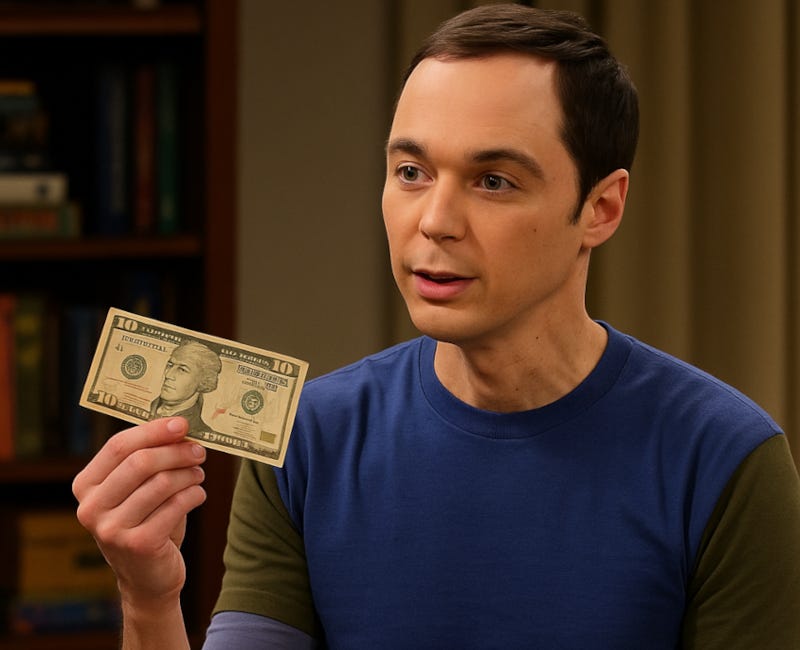
In Season 5 Episode 24, Sheldon receives a gift from soon-to-be-wed Howard. We are already aware, thanks to previous episodes, that the gift-giving custom is not necessarily something that is naturally compatible with Sheldon. Sheldon, however, accepts the gift, but immediately finds it is worth $100 and is alerted that the present he has bought for Howard, at $90 including card, is not of equal cost. To rectify the imbalance, Sheldon gives Howard $10, explaining that this means he is no longer in his debt.
This is where I dispute Sheldon’s logic. To equate valuation or worth to financial recompense is obtuse. Value is not a currency. In the case of Howard’s comic book, it may be priced at $100 but this is not to say it will sell (again) at that amount, and it is certainly not a direct substitute for cold, hard cash. So Sheldon is mixing two concepts when attempting to increase value with payment - one or the other must take precedence.
The scenario that Sheldon, in fact, creates is one tipped in Howard’s favour (or, if also suffering from Sheldon’s neurosis, Howard’s detriment). By providing Howard with $10 - again ignoring the $2 card punchline - he reduces Howard’s episodic losses to $90 whilst increasing his own to $100. The imbalance is merely switched rather than eradicated. He has put Howard in his debt - mistakenly, we will assume.
So what course of action should Sheldon have taken? There are two options. Both act as a microcosm of one of the major issues facing the developed world in 2012.
Firstly, let’s take the most logical course - certainly the most disaffected. Sheldon is man of absolutes. He seldom - no assonance pun intended - allows himself to be taken by emotion. So why then, when faced with a question of value, does he attempt to reciprocate the perceived worth of the gesture? The most Sheldon-like response would surely have been to give Howard $5, taking each participant’s losses to $95 and, hey presto, equilibrium is restored.
A no-brainer, huh? Wrong. Sadly, the perceived value of gestures is exactly what makes the world go round. Global commerce is so heavily influenced by the materialistic desires of children, the guilt of friends and the keeping of face around the Christmas dinner table that the notion of rectifying financial imbalances would derail (perhaps has derailed) the planet’s financial markets.
The crux is that in the episode in question, Howard pumped $100 into the economy, Sheldon $90, so the economy benefited to the tune of $190. Yes, Sheldon gave Howard a further $10, which may have been used to spend on a commercial item, but this is not guaranteed, nor is it calculable as being immediate. The danger is that society takes Sheldon’s approach and runs with it, i.e. both parties carry out a de facto swap of equal amounts of money, foregoing the gift exchange completely. No one spends a cent, penny or, pertinently, a eurocent on each other; people remain in the position they were in before the ritual was due to commence and retail receives nothing at all.
If Sheldon were conscientious, there is an argument to say he should have immediately gone out and boosted the US economy by purchasing something - anything - for $10. In their rudimentary definition of “worth”, the TBBT guys would have reinforced the economy by the maximum amount of $200. Sheldon could have helped more if he had erred on the side of caution to relieve his anxiety, buying a gift of greater cost to put Howard in his debt.
It may be a moot point but these kinds of decisions are costing the Western world. Maybe we deserve it, maybe the world will be a better place if capitalism does take a hit, but if we look shorter term, as the Independent infamously put it in a front page headline, we’ll only get through this if we spend, spend, spend.
Jay
If you enjoyed this article, you can donate here. Donations increase the likelihood of more articles being produced, as more time can be dedicated to the site.
If you are interested in the writer contributing to your own website or business in a very cheap guesting or ghostwriting capacity, then this can be explored here. If you are impressed with the spelling and grammar and you would like the writer to proof and edit your own content, click here for that very reasonably priced service.